Building date: Late 1930s (Crandall), 1840s or 1850s by Rushville Historian Robert E. Moody, demolished likely between 1877 and 1920.
Original use: Schoolhouse
Corner structures:
Mortar application and content:
Types and uses of stones: Washed cobblestones
Types and choice of windows:
Structures with similar masonry details: Phe-25 Round Jug School, #20 Dimock District, Pot-1 School District No 5., Phe-26 Schoolhouse District 19.
Masons who worked on building:
Unique features: Round cobblestone structure construction.
Map views courtesy Google Maps. Approximate location is Google Earth confirmed; 42°45'01.76"N 77°15'07.44"W.
Town of Middlesex and Yates County Maps.
Middlesex Pine Corners District #1 Round Jug Schoolhouse History Sheet, courtesy Karen Crandall.
Round Stone School House, School District No. 1, at Pine Corners NW side of the intersection of what is now Loomis Road just west of Route 245. Rushville Historian Robert E. Moody said it was built in the 1840s or 1850s but had a poor foundation, resulting in cracks in the walls. The building was considered dangerous and was torn down. A frame structure replaced it.
The following letter to the editor regarding this school house was written by Mrs. Franc Adams and was published in the Yates County Chronicle of Penn Yan on January 30, 1924.
Mrs. Franc Adams Tells of School at Pine Corners, Between Rushville and Middlesex
Dear Editor: The article on "The Little Red School House," by H.E. Matthews, which appeared in your columns recently, could not have been other than very interesting to your readers. If I may be allowed to judge them by myself, and I am sure they would be glad to see more articles from the same pen.
As I look over my shoulder down the road which leads to long ago, the first mile stone at the beginning of that long journey, is a very remarkable school house, though not of the type Mr. Matthews mentioned. It was the Round Stone school house at the foot of Sand Hill, near Pine Corners, on the road between Middlesex and Rushville. As far as I can learn there were never but two of those peculiar shaped school houses in the world. [Editor's Note: See Potter Rural School District No. 5, and Phe-25 Round Jug School, #20 Dimock District.] Sometime during the latter part of the 1830's, it was voted to replace the school house at that point with a new building, and it is said that men with teams were sent to the shores of Lake Ontario to procure cobble stones to use in the construction of it. I think we of today can hardly realize what that meant, a journey of 120 miles for each load, and over roads that bore no semblance to those we have now.
Many can remember this perfectly round building, which gave it its name, its interior conforming to the shape of the outside. The teacher's desk stood on a segment of the circle raised some inches above the rest of the floor, with the hats and bonnets of the pupils hung on the wall nearby. A huge stove utterly devoid of blacking, occupied the middle or the room. There were three rows of desks with seats holding two pupils each, the other benches made to fit the shape of the wall, making seats of various sizes.
There were three small blackboards, and in one side was a small cupboard where was kept a small globe from which every line had been obliterated, and a set of geometrical blocks, which are a great source of wonderment to me at the time I began school. The room could comfortably seat about forty pupils, but in the winter from sixty to sixty-five scholars ranging in age from five to twenty years, were crowded into it. There were windows in one-half of the room, and the embrasures in the thick wall were so deep, that the room was only well lighted when the sun was at the right height to shine directly through them.
My first recollection of this remarkable school house was on the 19th of June, 185-. That morning my mother dressed me in my Sunday best, for the first day at school was a notable event; I wore a Spencer waist of yellow dotted with black, a blue skirt, long pantalettes of embroidery, and red morocco shoes. Instead of a hat I wore a pink calico sunbonnet. I was placed in care of my cousin, Theodore Christie, as I was only "half-past four" and he was twelve. I felt very proud to have such a big boy as my escort.
My home was at the edge of the mill pond about a mile out of Rushville, my father owning the saw mill there at that time. David Christie, my uncle, owned the place across the road. "Flete" Miles lived next door to us and had a wagon shop in the back part of the house, while Philo Ayres lived at the foot of the knoll. We crossed West River near the schoolhouse and went on to the building where we were greeted by Miss Caroline Bennett, who was teaching the school. According to the custom of that day, she called the little folks to her side as soon as school began, where she pointed to the letters in the primer with oh, such a beautiful pen-knife, as we leaned against her knee and droned out the letters as she told them to us.
When we went out to play, we naturally gravitated to the river, or creek, where the warm weather had diminished the water until there were only nice warm pools where we could splash and splatter. Off came our shoes and stockings, as we began to catch the innumerable pollywogs found there.
I had been told that tadpoles dropped their tails when they turned into frogs, so suggested to my playmates that we assist nature. When the bell rang I still had several I had not abbreviated, so dropped them into the pocket of my dress, thinking to finish the job some other time. This proved my undoing, for as we were again called to read, the teacher noticed my wet dress, and thrust her hand into my pocket to determine its contents. She gave a wild scream and sent me back to the creek to dispose of my catch, and when I returned to the school room she laid me across her lap and spanked me before the entire school, and the humiliation of that moment has remained in my memory all my life. Before I had stopped sobbing, there was a knock at the door, and I was told that my father had come after me, and when I reached home, to my great joy, I found that a baby sister had taken up her abode with us during my absence.
Other teachers under whom I studied there were Miss Huldah Ann Van Osdol, Miss Andrews, and Jay Green, afterwards a well known physician. His school was a crowded one, with five Loomis children, Blairs, Ellicks, Miles, Ayres, Wrights, Hogans, Bucklins, Lindsleys, Fosters, Christies, Fergusons, and perhaps others that have slipped my mind. His term was a rather tempestuous one, with his Czar-like methods which the older pupils resented.
Fourteen years later I taught one summer in this same school house, and among my pupils were children of some of my former schoolmates. Some of my plans were not entirely approved by my patrons, but the county school commissioner to me to go ahead. I was only a little ahead of the times, for those things were coming. I had a little four octave melodeon which I took to school with me, and my pupils sang and marched during resting spells, and they did in no other school in the county, and my "mouse-trap" was severely scored by some of of the more old-fogyish ones.
There were five wee ones in school who had to come and go when the older children did, and with six full hours in school and walk of some miles each day, I thought they needed a rest, so every afternoon one part of the room was turned into a nursery, and these little folks all had a nice long nap.
But the most unpardonable thing of all, was the fact that on rainy days when these children could not go out to play, I furnished cord with which they drove chairs for horses, while some with tack hammers and tacks, made all sorts of designs with them in pieces of board, and the little girls brought their dollies to school. "O, me, O, my, think of paying a teacher for such folderol as that!" Yes, and they were allowed to draw pictures on their slates and on the blackboards, and even the little ones learned to draw geometrical figures and describe them.
I often wondered I came to get another school after all that hue and cry, but I did, and taught nine of those long, old-fashioned terms in Yates and Ontario counties.
After living in Michigan twenty-five years, I returned to my native haunts, and one of the greatest disappointments of my life was to see one of the conventional one-story uprights standing in the place of the stone school house. The second school house of that form and build was in the township of Potter, and was in use long after the one at Pine Corners had been razed. Both were historic buildings, and it would have added to the value of the county history had they been preserved.
When visiting with Miss Caroline Bennett after she had passed her ninetieth milestone, she spoke of that event which was such a tragedy to me, and mourned the fact of that lost opportunity to teach the pupils a lesson in natural history. "But, alas," she said, "we knew nothing of object lessons in those days, and any teacher who spent her time in those far-away days, talking about things not found in the school books, would have been severely censured. "Thank the Lord," she continued, "those days of such limited vision are past."
My, what a long-drawn-out story. Are you tired?
I have worlds of clippings from the Chronicle, which form a regular Yates county history for me, and in looking them over yesterday, I saw that the first man to settle in Yates county was Jacob Fredenburg. I had his Revolutionary record, from his great-grandson, the late George Haviland, of Rushville, but the above was something new.
He was born in 1759 at Livingston Manor, Columbia County, N.Y., and fought at Fort Edward, Fort Stanwix, and was at Stillwater age the capture of Burgoyne. He was a pensioner in Yates county. He is buried just over the Ontario county line, in the Baldwin Cemetery near Rushville. His grave is unmarked and is one of those of whom I sent a record to the Penn Yan D.A.R. Chapter. The name was spelled both Fredenburg and Vradenburg.
Yours truly,FRANC L. ADAMS.
Richard Palmer blog.
Editor's Note: FRANC L ADAMS - Frances Litelia Adams (1854-1930), married William J Adams, Mason, MI. She was born in Allegheny County NY and died in Ingham County MI, but apparently lived in the Middlesex area for a number of years. In researching who Franc L Adams was I discovered she was a real history buff and was prolific in her writing about the history of the areas where she lived, frequently published. Because of my findings when researching Mrs Adams, I accept her account about this cobblestone jug schoolhouse. Karen Crandall email 9/9/2021.
The Round Cobblestone School Houses", by Richard Palmer
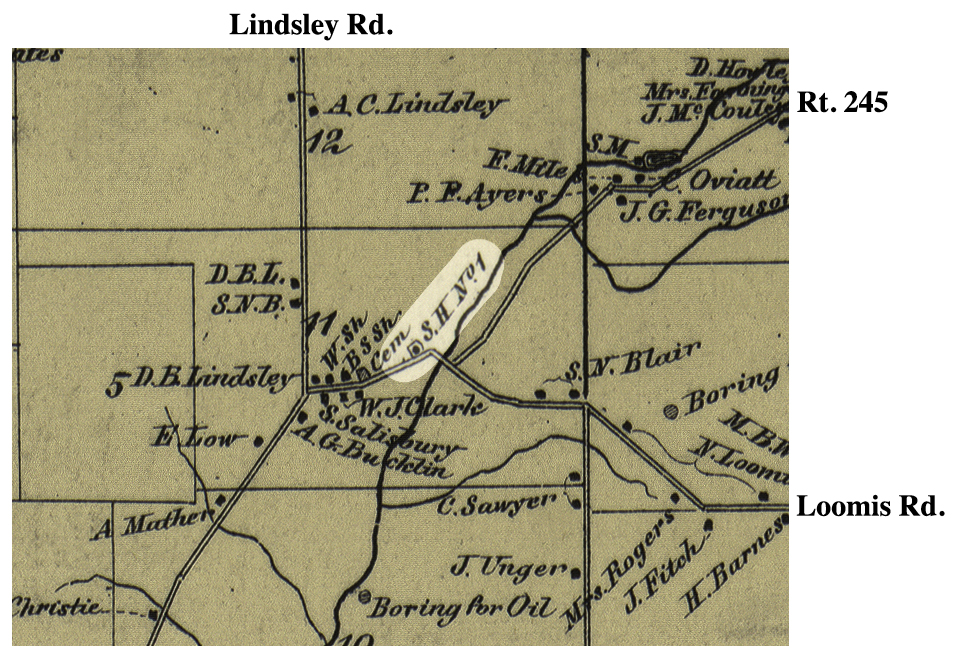 Yates County 1865 Map Excerpt A.jpg ¹ | 
|
¹ 1865 Yates County Map courtesy Library of Congress
